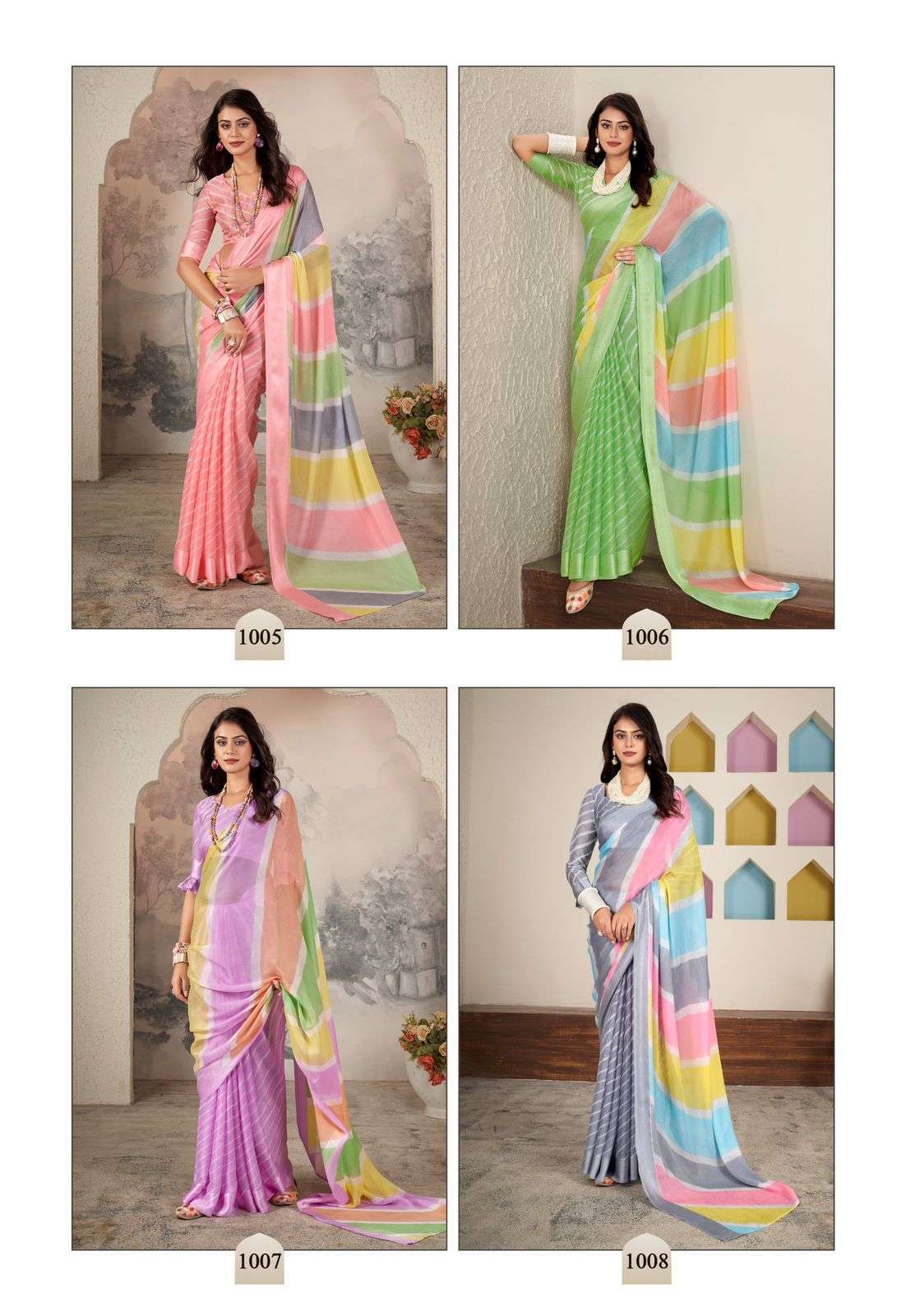
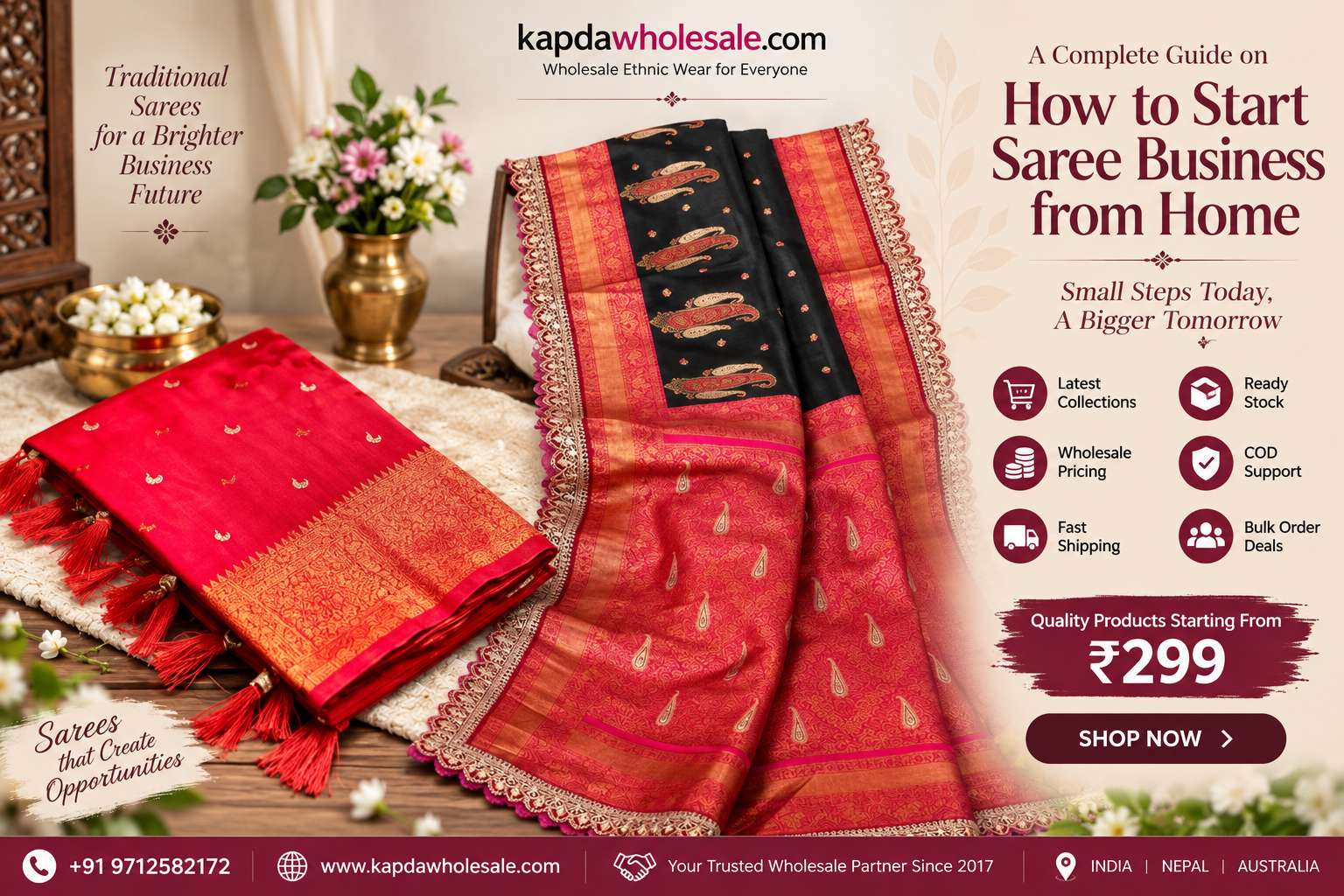
<h1><strong>How to Start Saree Business from Home in 2026 – Buy Wholesale Sarees from Surat</strong></h1> <p>Starting a home-based saree business can be a practical way to enter the ethnic wear market with controlled investment and flexible selling options. Instead of opening a showroom immediately, sellers can source carefully selected wholesale sarees, build a customer network through WhatsApp and social media, and gradually increase inventory according to actual sales. With access to Surat's extensive textile sourcing network through kapdawholesale.com, new and established resellers can purchase collections across different styles, budgets and customer segments.</p> <h2><strong>Introduction</strong></h2> <p>If you are planning <strong>how to start saree business from home</strong>, the first priority should be building a simple purchasing and selling system rather than investing heavily in stock from day one. Your business needs suitable products, competitive wholesale <strong>price</strong> levels, reliable sourcing, attractive catalogue presentation and a clear method for reaching customers.</p> <p>In 2026, a home-based seller can promote sarees through WhatsApp Status, customer groups, Instagram, Facebook and personal networks while keeping operating expenses considerably lower than a conventional retail setup. The business can begin with selected products and expand as the seller understands which fabrics, colours, price ranges and styles generate the strongest response.</p> <p>Surat provides a major sourcing advantage because the city has a broad textile trading, processing and <strong>manufacturing</strong> ecosystem. Retailers searching for <strong>wholesale sarees in Surat</strong> can find products ranging from everyday printed sarees to Bandhani, Paithani, fancy, silk-look, festive and wedding collections.</p> <p>kapdawholesale.com helps buyers explore these wholesale sourcing opportunities online, making it possible to build a saree resale business even when the seller is located outside Surat.</p> <h2><strong>Start a Saree Business from Home with Wholesale Stock</strong></h2> <p>A home-based saree business does not need to begin with hundreds of products. A more practical approach is to start with a curated assortment and increase stock only after understanding customer demand. This protects working capital and allows the seller to test multiple designs rather than committing heavily to one collection.</p> <p>For anyone evaluating <strong>how to start saree business from home</strong>, product selection should be connected directly to the intended customer. A seller targeting neighbourhood customers may require affordable daily and festive sarees, while a reseller serving premium clients may need better fabrics, distinctive designs and stronger presentation.</p> <h3><strong>Choose Your Target Saree Customer</strong></h3> <p>Before buying stock, decide who is most likely to purchase from you. Your target market could include working women, homemakers, wedding shoppers, festive buyers, premium boutique customers or budget-conscious families.</p> <p>Once the customer profile is clear, wholesale purchasing becomes more focused. Instead of selecting sarees simply because they look attractive, you can choose products that match your customers' preferred price range, fabric and occasion.</p> <h3><strong>Choose a Wholesale Saree Price Range</strong></h3> <p>Your buying price directly affects your retail margin. A home-based seller should calculate the wholesale rate, shipping expense, packaging and expected selling price before purchasing.</p> <p>Maintaining multiple price segments can work well. Affordable products can generate regular orders, while premium sarees can create higher-value sales. This also gives customers an opportunity to choose according to their individual budget.</p> <h3><strong>Start with Multiple Designs Instead of Heavy Quantity</strong></h3> <p>When starting a <strong>saree business from home</strong>, variety can be more useful than buying excessive quantity of the same design. Ten different styles can help you understand customer preferences more effectively than holding a large quantity of one untested product.</p> <p>After a particular design or category begins selling consistently, additional quantity can be purchased according to availability. This demand-based approach helps reduce slow-moving inventory.</p> <h2><strong>Buy Wholesale Sarees from Surat for Home Reselling</strong></h2> <p>Surat is closely associated with textile trading and garment supply across India. The wider <strong>surat textile market</strong> ecosystem around <strong>ring road</strong>, <strong>sahara darwaza</strong> and surrounding areas gives buyers access to a wide variety of fabrics and finished ethnic wear.</p> <p>Traditionally, retailers travelled to these markets to select stock. Online wholesale sourcing now makes it possible for home-based sellers in other cities to access collections without travelling for every purchase.</p> <p>This can significantly simplify a small reselling operation. Instead of spending additional time and money on repeated buying trips, sellers can review collections remotely and use their resources to purchase marketable inventory.</p> <h3><strong>Surat Saree Wholesale Price Advantage</strong></h3> <p>A competitive <strong>Surat saree wholesale price</strong> can provide room for resellers to create practical margins. However, the lowest rate should not be the only purchasing criterion.</p> <p>Fabric, print quality, colour combination, finishing, current demand and final retail value all matter. A slightly higher-priced saree that customers actively want may provide better inventory turnover than a cheaper product with limited demand.</p> <h3><strong>Access to Saree Manufacturing and New Collections</strong></h3> <p>Surat's textile <strong>manufacturing</strong> and trading network supports regular product development. New designs and colour combinations can enter the market frequently, giving home sellers opportunities to keep their catalogues updated.</p> <p>Fresh inventory is particularly valuable for WhatsApp and social media sellers because customers may stop responding when the same products are promoted repeatedly.</p> <h3><strong>Wholesale Saree Ready Stock for Faster Selling</strong></h3> <p><strong>Ready stock sarees wholesale</strong> can be useful when sellers want to purchase products already available for ordering instead of depending entirely on future production.</p> <p>When one catalogue begins generating enquiries, ready availability can shorten the gap between customer interest and stock purchase. Buyers should still confirm live quantity and colour availability because wholesale inventory can change quickly.</p> <h2><strong>Best Sarees to Buy for a Home-Based Saree Business</strong></h2> <p>The ideal product mix depends on your customers, location and selling channel. A new reseller can test several categories and gradually concentrate more purchasing on the products that deliver better sales.</p> <h3><strong>Paithani Sarees Wholesale for Wedding and Festive Buyers</strong></h3> <p><strong>Paithani sarees wholesale</strong> collections can help sellers target traditional, wedding and festive customers. Their distinctive ethnic appearance makes them suitable for buyers looking for stronger occasion-wear presentation.</p> <p>A home-based seller does not necessarily need large quantities of premium Paithani-style products initially. Selected colours and designs can be promoted to existing customers, with future purchasing adjusted according to response.</p> <h3><strong>Bandhani Sarees Wholesale for Traditional Customers</strong></h3> <p><strong>Bandhani sarees wholesale</strong> collections can be suitable for festive, traditional and family-function demand. Bright colour combinations and recognisable Bandhej-inspired patterns can make these sarees visually effective for WhatsApp and social media promotion.</p> <p>Resellers can maintain several price levels so both value-conscious and premium customers have suitable options.</p> <h3><strong>Fancy Sarees Wholesale for Trend-Based Selling</strong></h3> <p><strong>Fancy sarees wholesale</strong> products can give a home seller a broader contemporary selection. Lightweight fabrics, modern prints, stylish borders and fashionable colour combinations can be promoted for parties, functions, gifting and casual occasions.</p> <p>These collections can be particularly useful when the seller's customer network includes younger buyers who want ethnic styling without an overly traditional appearance.</p> <h3><strong>Wedding Sarees Wholesale for Higher-Value Orders</strong></h3> <p><strong>Wedding sarees wholesale</strong> buying can create opportunities for larger-value customer orders. Families shopping for weddings may require multiple sarees across different events and budgets, making this segment useful for sellers with strong local networks.</p> <p>Premium quality is especially important in this category because customers generally evaluate fabric, finishing, colour and detailing more carefully when purchasing for a major occasion.</p> <img src="https://kapdawholesale.com/images/product/2025/03/kapda-wholesale-kc-3088-wedding-wear-paithani-silk-saree-wholesale-manufacturers-in-surat-2025-03-03_19_03_00.jpeg"/> <h2><strong>How Much Investment Is Practical for a Home Saree Business?</strong></h2> <p>There is no single investment amount suitable for every seller. The practical budget depends on the number of designs purchased, wholesale price, product segment and whether the business keeps physical inventory or works with a more controlled catalogue-based model.</p> <p>Instead of asking only how much money is required, a better purchasing question is how much inventory you can reasonably sell within your customer network. This keeps the focus on stock rotation rather than simply building a large catalogue.</p> <h3><strong>Start Small and Reinvest from Sales</strong></h3> <p>New sellers can begin with selected products across multiple styles. Once orders begin coming in, a portion of the sales proceeds can be reinvested into new stock.</p> <p>This gradual approach can help the seller understand real demand before committing a larger amount. It also creates an opportunity to change the product mix if initial assumptions about customer preferences prove incorrect.</p> <h3><strong>Separate Your Buying Budget from Your Profit</strong></h3> <p>Home sellers should maintain a clear distinction between sales revenue, stock replacement money and actual profit. Using the entire sales amount as personal income can make it difficult to replenish inventory.</p> <p>A simple system of recording purchase price, selling price, shipping and other expenses can make the business easier to manage as order volume increases.</p> <h3><strong>Purchase According to Stock Rotation</strong></h3> <p>Fast-moving products can justify larger repeat purchases. Slow-moving designs should generally not receive additional investment merely because they are available at an attractive wholesale rate.</p> <p>By monitoring what customers actually purchase, a reseller can gradually develop a product mix based on sales evidence rather than guesswork.</p> <h2><strong>Sell Wholesale Sarees Through WhatsApp from Home</strong></h2> <p>WhatsApp can be one of the simplest selling channels for a new saree reseller because it provides direct access to friends, family contacts, existing customers and local communities.</p> <p>A seller can use WhatsApp Status to display new products, create customer groups for specific categories and communicate individually with repeat buyers. Catalogue photographs can be accompanied by basic product details, price and ordering instructions.</p> <h3><strong>Create Separate Customer Groups</strong></h3> <p>Instead of sending every product to every customer, sellers can organise buyers according to interest. One group may prefer budget sarees, another may want premium wedding collections, while another may be interested in festive styles.</p> <p>This targeted approach keeps promotions relevant and can reduce the chance of customers ignoring frequent messages.</p> <h3><strong>Post Fresh Saree Collections Regularly</strong></h3> <p>Regular product updates give customers a reason to continue checking your Status. A seller does not need to upload the entire inventory every day; selected new arrivals can create a cleaner and more focused presentation.</p> <p>kapdawholesale.com can support buyers looking for new wholesale collections that can be selected according to their target market and purchasing requirements.</p> <h3><strong>Build Trust with Clear Product Information</strong></h3> <p>Customers purchasing remotely should receive accurate information about fabric, colour, product details and price. Clear communication reduces misunderstandings and helps build repeat business.</p> <p>When a seller consistently supplies products that match the catalogue presentation and promised quality level, customers are more likely to return for future purchases.</p> <h2><strong>Set the Right Resale Price for Your Sarees</strong></h2> <p>Pricing should cover the wholesale purchase rate and all relevant selling costs while still leaving a reasonable margin. Sellers should account for shipping, packaging, payment charges where applicable and promotional discounts before deciding the final retail price.</p> <p>It is also useful to understand the local market. A price that works for a premium customer group may not work for a highly price-sensitive neighbourhood market.</p> <h3><strong>Do Not Compete Only on Lowest Price</strong></h3> <p>A home-based seller can create value through product selection, personal service, convenient ordering and trustworthy recommendations. Competing only by reducing price can gradually weaken margins.</p> <p>Customers may be willing to pay a fair premium when the seller offers better designs, reliable quality and responsive service.</p> <h3><strong>Create Different Retail Price Levels</strong></h3> <p>Maintaining affordable, mid-range and premium options allows the business to serve more customers. It also gives sellers opportunities to upgrade a customer when a better product provides visibly stronger value.</p> <p>Selected ethnic wear categories may include <strong>quality products starting from ₹299</strong>, subject to current product and stock availability. Saree prices themselves vary according to fabric, workmanship, design and collection.</p> <h2><strong>Build Your Saree Business for India, Nepal and Australia</strong></h2> <p>A home-based ethnic wear business can begin locally and gradually reach customers beyond the seller's immediate area. Digital communication and shipping services allow resellers to build networks across cities and, where practical, international markets.</p> <h3><strong>Home-Based Saree Selling Across India</strong></h3> <p>For sellers in <strong>India</strong>, wholesale sourcing from Surat can support sales in different cities and states. Buyers can select products online and confirm available shipping or transport arrangements according to their location.</p> <h3><strong>Saree Reselling Opportunities in Nepal</strong></h3> <p>Retailers and resellers serving <strong>Nepal</strong> can select traditional, festive and wedding-oriented sarees according to local demand. Cross-border buyers should confirm current payment, shipping and <strong>export</strong> arrangements before finalising purchases.</p> <h3><strong>Indian Saree Reselling in Australia</strong></h3> <p>Home-based sellers and boutiques serving Indian and South Asian communities in <strong>Australia</strong> can source sarees according to local customer preferences. International buyers should calculate product cost, freight and expected resale value when planning quantities.</p> <p>For larger export purchases, consolidated buying can sometimes make shipping more practical than sending frequent small consignments.</p> <h2><strong>Use Vastralife’s Wholesale Experience to Source Better</strong></h2> <p>Product sourcing becomes increasingly important as a home business grows. Customers may forgive a small seller for having limited inventory, but repeated problems with product quality or unreliable sourcing can quickly damage trust.</p> <p>Vastralife has wholesale and <strong>export</strong> experience since 2017, supported by practical textile industry expertise. This experience is relevant for home-based sellers as well as shop owners, boutique owners, showroom owners, resellers and larger wholesale buyers looking for dependable ethnic wear sourcing.</p> <p>Premium product quality should remain part of the buying decision even when the business is targeting affordable price segments. A customer who is satisfied with the first purchase has a greater chance of becoming a repeat buyer, making quality important for long-term growth.</p> <h2><strong>Turn a Small Home Saree Business into a Scalable Reselling Model</strong></h2> <p>Understanding <strong>how to start saree business from home</strong> is only the first stage. The larger opportunity comes from creating a repeatable system where new collections are sourced, promoted, sold and replenished according to customer response.</p> <p>A seller can begin with personal contacts, gradually build WhatsApp customer groups, add social media selling and later expand into a dedicated online store or physical retail presence if sales justify the investment.</p> <p>The most important principle is to let customer demand guide expansion. A business that consistently reinvests in fast-moving products can grow more sustainably than one that purchases large quantities without a clear selling plan.</p>
<p>As the business becomes more consistent, sellers can expand gradually by increasing fast-moving inventory, adding new price segments and building a stronger repeat-customer base. The aim should be controlled growth where each new investment in stock is supported by actual enquiries, previous sales and realistic resale opportunities.</p> <h2><strong>Create a Profitable Product Mix for Your Home Saree Business</strong></h2> <p>A profitable saree catalogue should not depend entirely on one fabric, one price point or one occasion. Customers purchase sarees for daily wear, gifting, weddings, festivals, religious occasions, family functions and personal collections. A varied inventory allows the seller to respond to these different buying needs.</p> <p>Home-based sellers can divide their purchasing budget between affordable fast-moving products, mid-range fashionable sarees and selected premium pieces. This makes the catalogue suitable for customers with different spending capacities without requiring excessive inventory in every segment.</p> <h3><strong>Keep Fast-Moving Sarees for Regular Orders</strong></h3> <p>Affordable printed, lightweight and easy-to-wear sarees can help generate regular orders. These products are particularly useful when the customer base includes buyers who frequently purchase sarees for everyday use, gifting or casual functions.</p> <p>Once a particular fabric or price range starts selling consistently, sellers can increase its share of the next wholesale purchase. This helps build inventory around proven demand.</p> <h3><strong>Add Premium Sarees for Better Order Value</strong></h3> <p>Premium products can increase the average value of individual orders. Paithani-inspired sarees, premium festive collections and wedding-focused designs can be shown selectively to customers who value better presentation and are comfortable with a higher retail price.</p> <p>The product photographs, fabric details and overall presentation should accurately represent the collection. Premium customers generally evaluate quality more carefully before placing an order.</p> <h3><strong>Keep Seasonal Collections Ready</strong></h3> <p>Festivals and wedding seasons can create sudden buying opportunities. Sellers who prepare their stock early have more time to show products to customers and identify which designs deserve replenishment.</p> <p>Instead of waiting until demand reaches its peak, buyers can begin purchasing seasonal collections in advance and use WhatsApp or social media to start generating enquiries.</p> <h2><strong>Manage Inventory Without Over-Investing</strong></h2> <p>Inventory management is one of the most important parts of a home-based fashion business. Purchasing too little can result in missed sales, while purchasing too much can lock working capital into products that may take months to sell.</p> <p>New sellers can maintain a simple record containing product name, purchase price, quantity, selling price, units sold and remaining stock. Even a basic spreadsheet can make purchasing decisions considerably more disciplined.</p> <h3><strong>Identify Your Fast-Moving Sarees</strong></h3> <p>Track which sarees generate actual sales rather than only likes or enquiries. A product receiving many WhatsApp responses but very few confirmed orders should not automatically receive a large repeat purchase.</p> <p>Confirmed sales provide a stronger indication of demand. Use this information when deciding which fabrics, designs and price points deserve more inventory.</p> <h3><strong>Clear Slow-Moving Stock Strategically</strong></h3> <p>Some products will inevitably move more slowly. Instead of keeping them indefinitely, sellers can create limited promotions, bundle offers or special customer deals while protecting as much margin as possible.</p> <p>Clearing older stock releases capital for new collections and keeps the catalogue visually fresh.</p> <h3><strong>Reorder Before Popular Stock Is Completely Finished</strong></h3> <p>If a saree collection is selling consistently, check replenishment availability before the final piece is sold. This reduces the possibility of receiving additional customer enquiries after stock has already disappeared.</p> <p>Ready-stock wholesale sourcing can be particularly useful for this purpose, although current availability should always be reconfirmed when the repeat order is placed.</p> <h2><strong>Build Customer Trust When Selling Sarees from Home</strong></h2> <p>A home-based seller does not have a large showroom to establish credibility, so customer trust is built through communication, product quality and consistent service. Every successful delivery contributes to the reputation of the business.</p> <p>Share accurate product details, avoid making unrealistic promises and communicate clearly about dispatch and delivery expectations. Customers who receive what they expected are more likely to purchase again and recommend the seller to others.</p> <h3><strong>Use Clear Product Images</strong></h3> <p>Customers should be able to understand the saree's overall appearance before ordering. Use clear catalogue images and provide relevant product details rather than relying on vague descriptions.</p> <p>If colour variation is possible because of lighting or screen settings, communicating this appropriately can also help manage expectations.</p> <h3><strong>Maintain Transparent Pricing</strong></h3> <p>Customers should understand the final selling price and any applicable shipping charge before confirming their purchase. Clear pricing reduces unnecessary negotiation and prevents misunderstandings after the order is placed.</p> <h3><strong>Encourage Repeat Customers</strong></h3> <p>After completing an order successfully, keep the customer connected with future collections without overwhelming them with messages. New arrivals relevant to their previous purchases can be shared selectively.</p> <p>A customer who has already purchased successfully can be easier to convert again than an entirely new lead, making repeat business valuable for long-term growth.</p> <img src="https://kapdawholesale.com/images/product/2025/01/dazira-beej-paithani-saree-wholesale-market-in-surat-2025-01-22_18_33_36.jpeg" /> <h2><strong>Internal Linking for More Wholesale Ethnic Wear Opportunities</strong></h2> <p>Home-based sellers looking to build a traditional premium collection can explore <a href="https://www.kapdawholesale.com/paithani-saree">Paithani saree wholesale</a> options and select suitable products according to their customer budget and festive requirements.</p> <p>As the business expands beyond sarees, sellers can also explore a <a href="https://www.kapdawholesale.com/lehenga-wholesaler-in-surat">lehenga wholesaler in Surat</a> for wedding, festive and occasion-focused inventory. Adding complementary ethnic wear categories can increase selling opportunities within an existing customer network.</p> <p>Diversification should still be gradual. It is better to establish regular sales in the core saree category before investing heavily across too many unrelated product segments.</p> <h2><strong>Grow Your Home Saree Business Through WhatsApp and Social Media</strong></h2> <p>Once the initial customer base has been established, digital selling can help the business reach beyond personal contacts. WhatsApp, Instagram and Facebook can work together to create visibility while direct customer communication remains an important part of conversion.</p> <h3><strong>Use WhatsApp Status for Daily Selling</strong></h3> <p>WhatsApp Status can function like a small daily storefront. Sellers can post selected new arrivals, available colours, festive recommendations and limited-stock products throughout the week.</p> <p>Rather than uploading excessive numbers of images together, a smaller selection can make individual products easier to notice.</p> <h3><strong>Create Instagram Reels for Saree Collections</strong></h3> <p>Short videos can demonstrate drape, fabric movement, colour and detailing more effectively than a single static photograph. Home sellers can create simple product-focused videos without requiring a professional studio for every post.</p> <p>The content should ultimately guide interested viewers toward an enquiry or purchase instead of generating views without a clear selling path.</p> <h3><strong>Build a Customer Broadcast List</strong></h3> <p>Existing buyers and interested prospects can be organised into appropriate communication lists. New collections can then be shared with customers who have already expressed interest in sarees.</p> <p>Relevant communication generally performs better than sending every catalogue to every contact.</p> <h2><strong>Scale from Home Seller to Boutique or Showroom</strong></h2> <p>A successful home-based saree business can eventually expand into a larger operation, but physical expansion should follow consistent sales rather than come before them.</p> <p>Once the business develops regular monthly orders, predictable inventory rotation and a stable customer base, the seller can evaluate whether a dedicated studio, boutique or retail shop would create enough additional sales to justify the expense.</p> <h3><strong>When to Increase Wholesale Buying</strong></h3> <p>Increase quantities when sales data supports the decision. If certain categories repeatedly sell out and customers continue requesting them, deeper purchasing may improve availability and margins.</p> <p>Bulk purchasing should not be based only on a supplier offering a lower rate. The business still needs enough customers to move that additional inventory.</p> <h3><strong>When to Add New Product Categories</strong></h3> <p>Customer requests can guide expansion. If regular saree buyers repeatedly ask for lehengas, suits or other ethnic wear, testing a limited assortment may create additional sales without requiring an entirely new customer base.</p> <h3><strong>When to Consider a Physical Store</strong></h3> <p>A physical store can become relevant when customers regularly request in-person viewing, the home setup becomes too small for inventory, or existing sales can comfortably support rent and operating expenses.</p> <p>Until then, the lower overhead of a home business can remain a significant advantage.</p> <h2><strong>Saree Business Opportunities Across India, Nepal and Australia</strong></h2> <p>A well-organised sourcing and selling model can serve customers beyond one neighbourhood. Sellers should expand geographically only when shipping, payment and customer service can be handled reliably.</p> <h3><strong>Sell Sarees Across India</strong></h3> <p>Home-based sellers in <strong>India</strong> can use courier and transport services to serve customers beyond their own city. This expands the potential market while allowing the business to continue operating from home.</p> <p>Wholesale sourcing from Surat can provide access to fresh designs without requiring sellers to repeatedly visit <strong>ring road</strong>, <strong>sahara darwaza</strong> or other areas of the <strong>surat textile market</strong>.</p> <h3><strong>Build a Saree Reselling Business for Nepal</strong></h3> <p>Businesses serving <strong>Nepal</strong> can select traditional, festive and wedding-oriented products according to local customer demand. Buyers should confirm current payment, shipping and cross-border arrangements before finalising wholesale purchases.</p> <h3><strong>Source Indian Sarees for Australia</strong></h3> <p>Home-based sellers and boutiques serving South Asian customers in <strong>Australia</strong> can source Indian sarees according to local demand and retail positioning. Product price, freight and expected resale value should all be calculated when planning an international purchase.</p> <p>Larger consolidated <strong>export</strong> orders may provide a more practical shipping structure than repeatedly dispatching small wholesale consignments.</p> <h2><strong>Why Buy Wholesale Sarees from kapdawholesale.com</strong></h2> <p>kapdawholesale.com is designed for buyers looking to source ethnic wear for resale, whether they are starting from home or already operating a boutique, shop or showroom. Access to online wholesale collections can simplify sourcing for buyers who cannot visit Surat every time they need new inventory.</p> <p>The right wholesale source should help a reseller access multiple price segments and regularly changing designs. This allows the seller to adapt purchasing according to actual customer response.</p> <h3><strong>Latest Collections</strong></h3> <p><strong>Latest Collections</strong> help home sellers keep their WhatsApp and social media catalogues fresh. Regular new arrivals give existing customers a reason to continue checking for new designs.</p> <h3><strong>Wholesale Pricing</strong></h3> <p><strong>Wholesale Pricing</strong> provides the foundation for resale margins. Buyers can choose affordable, regular and premium collections according to their target customers and selling strategy.</p> <h3><strong>Trendy Ethnic Wear</strong></h3> <p><strong>Trendy Ethnic Wear</strong> allows sellers to offer more than traditional basics. Fashion-oriented sarees, festive products and other ethnic categories can help build a broader customer offering.</p> <h3><strong>Fast Shipping</strong></h3> <p><strong>Fast Shipping</strong> can help resellers replenish inventory and fulfil customer requirements more efficiently. Actual dispatch and delivery schedules depend on stock, order quantity and destination and should be confirmed when ordering.</p> <h3><strong>COD Support</strong></h3> <p><strong>COD Support</strong> may be available for eligible Indian wholesale orders according to applicable conditions. Buyers should confirm the current advance requirement, minimum order value and delivery eligibility before purchase.</p> <h3><strong>Bulk Order Deals</strong></h3> <p><strong>Bulk Order Deals</strong> can become relevant as the home business grows and starts requiring larger quantities. Buyers can enquire according to their preferred category, target price and quantity.</p> <h3><strong>Quality Products Starting From ₹299</strong></h3> <p><strong>Quality Products Starting From ₹299</strong> may be available across selected ethnic wear categories depending on current stock and collection. Individual saree prices vary according to fabric, design, workmanship and range.</p> <h2><strong>Customer FAQs</strong></h2> <h3><strong>1. Can I start a saree business from home in 2026?</strong></h3> <p>Yes. A home-based seller can source wholesale sarees, promote them through WhatsApp and social media and gradually build inventory according to confirmed sales. Starting with controlled quantities can reduce unnecessary stock investment.</p> <h3><strong>2. Where can I buy sarees wholesale for reselling?</strong></h3> <p>Buyers can explore wholesale ethnic wear collections through kapdawholesale.com and select products according to their customer segment, budget and quantity requirements.</p> <h3><strong>3. Do I need a physical shop to start selling sarees?</strong></h3> <p>No. Many sellers can begin from home and use WhatsApp, Instagram, Facebook and personal customer networks to generate orders before considering a physical retail setup.</p> <h3><strong>4. Which sarees should I buy first for reselling?</strong></h3> <p>A balanced starting selection can include affordable everyday sarees, fashionable products and a limited number of festive or premium styles. The exact mix should reflect your target customers.</p> <h3><strong>5. Can I buy Paithani sarees at wholesale prices?</strong></h3> <p>Paithani and Paithani-inspired collections can be sourced according to current availability. These styles can be particularly useful for wedding, festive and traditional customer segments.</p> <h3><strong>6. Can home-based sellers purchase ready stock sarees?</strong></h3> <p>Yes. Ready-stock sourcing can help sellers purchase currently available products for quicker resale, subject to live stock confirmation at the time of ordering.</p> <h3><strong>7. Is COD available for wholesale orders?</strong></h3> <p>COD support may be available for eligible Indian orders under applicable conditions. Buyers should confirm the current payment policy and delivery eligibility before placing the order.</p> <h3><strong>8. Can I order wholesale sarees outside India?</strong></h3> <p>International wholesale and export requirements can be discussed according to destination, quantity and available logistics. Buyers should calculate shipping costs and confirm applicable terms before purchase.</p> <h3><strong>9. How can I increase profit in a home saree business?</strong></h3> <p>Focus on fast-moving stock, maintain sensible margins, control unnecessary inventory, encourage repeat customers and reinvest part of the sales revenue into products that have demonstrated actual demand.</p> <h3><strong>10. Can I expand my home saree business later?</strong></h3> <p>Yes. As sales become consistent, a seller can increase wholesale quantities, add new ethnic wear categories, expand online selling or eventually consider a boutique or showroom when the business can support the additional expense.</p> <h2><strong>Start Your Home Saree Business with Wholesale Stock Today</strong></h2> <p>If you have been planning <strong>how to start saree business from home</strong>, begin with a clear customer segment, controlled investment and products selected for realistic resale demand. You do not need a large showroom or excessive stock to take the first step; a carefully chosen wholesale collection and a reliable customer network can provide a practical foundation for growth.</p> <p>Explore <strong>Latest Collections</strong>, competitive <strong>Wholesale Pricing</strong>, <strong>Trendy Ethnic Wear</strong>, <strong>Fast Shipping</strong>, eligible <strong>COD Support</strong>, attractive <strong>Bulk Order Deals</strong> and <strong>Quality Products Starting From ₹299</strong>.</p> <p>With Vastralife's wholesale and export experience since 2017, practical textile industry expertise and a focus on premium product quality, resellers can source collections according to their customers, selling price and inventory requirements.</p> <p><strong>Contact Number:</strong> +91 9712582172</p> <p><strong>Website:</strong> kapdawholesale.com</p> <p>Choose your first wholesale saree collection, start selling from home and expand step by step as your customer base and repeat orders grow in 2026.</p>