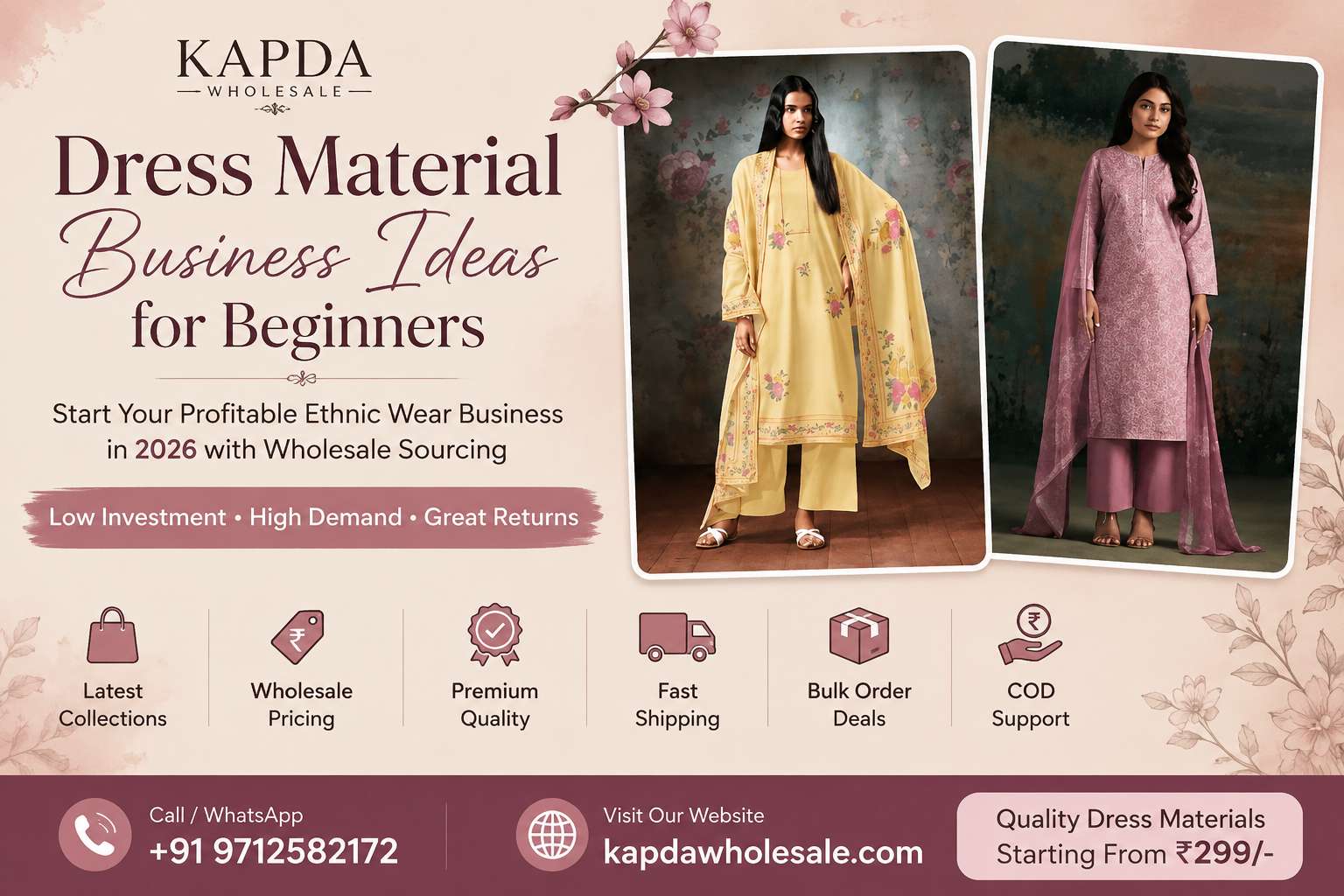
<h1><strong>Dress Material Business Ideas for Beginners: Start Wholesale Reselling in 2026</strong></h1> <p>Starting a women's ethnic wear business becomes easier when you have access to the right products, reliable wholesale sourcing and price ranges that leave enough room for resale margins. For beginners entering the clothing trade in 2026, unstitched suits and dress materials offer several selling opportunities across boutiques, home-based businesses, retail stores, WhatsApp selling and online reselling. The key is to purchase commercially attractive collections in manageable quantities and build inventory around products your customers are ready to buy.</p> <h2><strong>Introduction</strong></h2> <p>The Indian ethnic wear market gives new sellers an opportunity to begin without manufacturing their own garments. Instead of investing immediately in machinery, workers, fabrics and production infrastructure, beginners can purchase ready wholesale collections and resell them according to their target market.</p> <p>This is why <strong>dress material business ideas for beginners</strong> are particularly relevant for Home-Based Sellers, Boutique Owners and Resellers. Dress materials can be sold in different fabrics, patterns, price segments and styling categories. A seller can stock cotton suits for regular customers, designer collections for boutiques, embroidered suits for festive demand and premium ranges for customers seeking higher-value products.</p> <p>Buyers searching for a <strong>dress material wholesale supplier</strong> can source from Surat, one of India's major textile trading and manufacturing centres. The large network around the <strong>surat textile market</strong>, Ring Road and Sahara Darwaza gives wholesalers access to a wide range of fabrics, brands, manufacturers and trading houses.</p> <p>For businesses that prefer online purchasing, kapdawholesale.com provides another sourcing route for discovering wholesale ethnic wear collections without depending entirely on repeated physical market visits.</p> <h2><strong>Start a Home-Based Dress Material Reselling Business</strong></h2> <p>A home-based setup is one of the most practical entry models for someone who wants to purchase wholesale clothing and resell it without immediately opening a showroom. The business can begin with a selected stock of products rather than an oversized inventory.</p> <p>Beginners can purchase <strong>dress materials in bulk</strong>, photograph or share available designs, promote them through WhatsApp, Instagram, Facebook and local customer groups, and accept orders directly from interested buyers. As sales increase, the seller can reinvest part of the earnings into fresh stock.</p> <h3><strong>Buy Multiple Price Ranges for Better Customer Conversion</strong></h3> <p>Do not build the entire business around one price category. Some buyers may want economical daily-wear suits, while others may specifically ask for premium embroidery, branded collections or festive designs.</p> <p>A practical buying strategy can include entry-level products, mid-range designs and selected premium collections. This allows the seller to respond when customers ask for a particular budget instead of losing the sale because the available stock is either too cheap or too expensive.</p> <p>When comparing <strong>wholesale dress material price</strong>, calculate more than the supplier's quoted product rate. Freight, applicable taxes, packaging and other selling expenses influence the actual cost of every piece. A product with an attractive purchase rate is useful only when the final landed cost still allows a workable resale margin.</p> <h3><strong>Purchase Small Test Quantities Before Scaling</strong></h3> <p>New sellers can reduce inventory risk by testing collections before making larger purchases. Select a commercially balanced assortment, monitor inquiries and repeat orders, and then increase quantities for designs that customers actually purchase.</p> <p>This approach is especially useful when testing a new fabric, supplier, design family or selling location. Successful designs can be reordered while slow-moving styles do not consume a large percentage of working capital.</p> <h2><strong>Open a Local Dress Material Retail Shop</strong></h2> <p>Entrepreneurs with access to a suitable retail location can develop a dedicated ethnic wear shop. Rather than competing only on low price, a new store can create a clear product identity around cotton dress materials, premium suits, festive collections, printed sets or a combination of popular categories.</p> <p>A local shop provides customers with the advantage of seeing fabric, colour, print and finishing before purchasing. This can be particularly useful for buyers who prefer physically evaluating ethnic wear.</p> <h3><strong>Source Directly from Wholesale Markets</strong></h3> <p>Retailers looking for <strong>dress material wholesale in Surat</strong> frequently explore the textile commercial belt around Ring Road and <strong>Sahara Darwaza</strong>. The area provides access to multiple suppliers and product categories, making it possible to compare collections according to design, fabric, brand and wholesale price.</p> <p>However, travelling repeatedly to Surat is not convenient for every Shop Owner. Online wholesale sourcing can reduce the need for frequent buying trips, particularly when the retailer already understands the types of products that perform well in the store.</p> <p>Through kapdawholesale.com, wholesale buyers can explore ethnic wear collections intended for resale and select products according to their business requirements.</p> <h2><strong>Build a Boutique Dress Material Business</strong></h2> <p>Boutique customers often purchase differently from mass-market customers. They may look for better presentation, distinctive prints, attractive dupattas, premium fabrics, embroidery and designs that are less commonly available in ordinary stores.</p> <p>This creates a transactional opportunity for sellers who source <strong>designer dress materials wholesale</strong> and position them for boutique customers. Instead of stocking hundreds of similar designs, a boutique can purchase curated collections with multiple looks and selling prices.</p> <h3><strong>Stock Designer and Premium Collections</strong></h3> <p>A boutique can combine everyday commercial products with premium pieces for festive and occasion-driven purchases. Chanderi-inspired looks, embroidered suits, cotton collections, silk-blend dress materials, jacquard designs, printed suits and premium dupatta combinations can serve different customer requirements.</p> <p>Product presentation also matters. High-quality images, accurate fabric details, clear pricing and coordinated merchandising can make a wholesale-sourced product more appealing to retail customers.</p> <h3><strong>Create a Pre-Order Model</strong></h3> <p>A pre-order model can help beginners sell a wider range without purchasing every design beforehand. Sellers can showcase supplier collections, take confirmed customer orders and then purchase the required products subject to stock availability.</p> <p>This model can be particularly useful for expensive or experimental collections. It does not eliminate the need for working capital, but it can reduce unnecessary inventory when used with reliable wholesale suppliers and clear customer communication.</p> <img src="https://kapdawholesale.com/images/product/2026/06/ganga-aadila-4810-designer-dress-materials-in-bulk-2026-06-18_18_42_01.jpeg" /> <h2><strong>Start a WhatsApp Dress Material Wholesale Reselling Business</strong></h2> <p>WhatsApp-based reselling is another low-infrastructure model for beginners. A seller can create customer groups or broadcast lists, share fresh wholesale collections and accept orders without operating a traditional showroom.</p> <p>The model works particularly well when the seller has a reliable supply of <strong>latest dress material collections</strong>. Customers who repeatedly receive new designs have more reasons to revisit the seller instead of seeing the same inventory for several weeks.</p> <h3><strong>Use Wholesale Catalogues to Generate Orders</strong></h3> <p>Catalogues can help Resellers present multiple colours and designs quickly. Instead of purchasing every catalogue immediately, beginners can identify the collections generating the highest number of genuine inquiries and purchase accordingly.</p> <p>For ready-stock selling, maintain clear records of available pieces. Nothing damages buyer confidence faster than repeatedly confirming products that are already sold out.</p> <h3><strong>Create Separate Customer Segments</strong></h3> <p>A single WhatsApp audience may include budget buyers, boutique customers and retailers. Sending identical products to everyone can reduce conversion. Segment customers according to buying behaviour and send relevant collections.</p> <p>For example, a reseller interested in ₹500–₹800 products should receive a different selection from a boutique buyer regularly purchasing premium sets. Better targeting can generate more useful inquiries and improve the productivity of every catalogue shared.</p> <h2><strong>Sell Dress Materials Through Instagram and Social Commerce</strong></h2> <p>Instagram can function as a visual storefront for beginners who do not yet operate an ecommerce website. Sellers can create posts and short videos featuring fabric details, embroidery, dupatta designs, colour options and available wholesale or retail rates.</p> <p>The business can then direct serious buyers toward WhatsApp or another order channel. Sellers targeting <strong>ethnic wear wholesale buyers</strong> should make it clear whether prices are wholesale, retail or available only above a specified quantity.</p> <p>A beginner can also combine ready inventory with catalogue-based selling. Ready stock creates confidence because products are immediately available, while catalogue selling expands the number of options without requiring every piece to remain physically stocked.</p> <h2><strong>Purchase from Surat and Sell in Other Indian Cities</strong></h2> <p>One of the strongest <strong>dress material business ideas for beginners</strong> is geographical price and assortment arbitrage: sourcing collections from a major textile hub and selling them in markets where customers have less direct access to Surat suppliers.</p> <p>Retailers in smaller cities can purchase products from the <strong>surat textile market</strong> and build local collections around their customers' preferred designs. The opportunity is not simply to buy cheaply. The real value comes from selecting products that match local purchasing behaviour and presenting them conveniently to the customer.</p> <h3><strong>Use Surat's Manufacturing Ecosystem</strong></h3> <p>Surat's large textile <strong>manufacturing</strong> and trading ecosystem gives wholesale buyers access to frequent launches across numerous ethnic wear categories. For a beginner, this variety makes it possible to build a focused assortment rather than depending on a single product style.</p> <p>Buyers can source cotton suits, printed dress materials, designer suits, embroidered collections, festive ranges, Pakistani-style suits and other women's ethnic wear according to their customer base.</p> <p>Vastralife's wholesale and <strong>export</strong> experience since 2017 adds industry knowledge developed through years of working with textile products, wholesale customers and different markets. For new sellers, working with experienced sourcing networks can be valuable when product quality and consistent supply matter as much as price.</p> <h2><strong>Build a B2B Dress Material Supply Business</strong></h2> <p>Beginners do not necessarily have to sell directly to end consumers. Another model is supplying products to small boutiques, Home-Based Sellers and local clothing stores that need fresh merchandise but cannot regularly purchase directly from large textile markets.</p> <p>In this model, the entrepreneur becomes a local sourcing link. Products are purchased at wholesale rates and redistributed to smaller businesses with an appropriate margin.</p> <h3><strong>Target Boutiques and Home-Based Sellers</strong></h3> <p>Small fashion sellers frequently need new collections but may not have the volume, time or logistics to coordinate purchases from multiple suppliers. A local distributor who offers ready stock in relevant price bands can solve this purchasing problem.</p> <p>The seller can create different order slabs for resellers, boutiques and larger Shop Owners. This allows the business to protect margins while rewarding buyers who place higher-volume orders.</p> <h3><strong>Offer Repeat Wholesale Supply</strong></h3> <p>The goal should be to turn occasional purchasers into repeat wholesale customers. Consistent quality, transparent rates, timely dispatch and regular new collections can make this possible.</p> <p>For B2B selling, customer lifetime value can be more important than maximizing profit on one transaction. A boutique that purchases repeatedly throughout the year can become substantially more valuable than a one-time buyer attracted only by a temporary discount.</p> <p>In the next stage, beginners can expand from domestic selling into specialised categories, online wholesale ordering and international markets such as Nepal, Singapore and the USA while building their purchasing strategy around reliable supply, commercial price points and scalable order volumes.</p>
<img src="https://kapdawholesale.com/images/product/2026/06/ganga-drusilla-4906-wholesale-dress-material-shops-in-kolkata-2026-06-17_17_32_12.jpeg" /> <h2><strong>Expand Your Dress Material Business into Export Markets</strong></h2> <p>Once domestic sales become consistent, beginners can explore international demand for Indian ethnic wear. Dress materials are commercially attractive for overseas Resellers, Boutique Owners and ethnic fashion stores because unstitched products provide flexibility in sizing and tailoring. Buyers can purchase designs in bulk and have them stitched according to local customer requirements.</p> <p>Markets such as <strong>Nepal, Singapore and the USA</strong> can provide opportunities for sellers dealing in Indian ethnic fashion. Instead of trying to enter several countries simultaneously, beginners can identify one target market, study the preferred product category and purchase accordingly.</p> <p>For example, overseas boutique customers may prefer premium cotton, embroidered suits, designer dress materials, festive collections or Pakistani-style designs. The correct assortment depends on customer demographics, local climate, occasion demand and target retail price.</p> <h3><strong>Calculate Export Cost Before Confirming Your Selling Price</strong></h3> <p>International selling requires accurate costing. The purchase rate alone should never determine the final export quotation. A Wholesale Buyer should consider product value, packaging, transportation, applicable documentation, freight and destination-related expenses wherever relevant.</p> <p>For this reason, sellers entering the <strong>dress material export business</strong> should calculate the landed cost before committing to a customer price. A competitive quotation is useful only when it still protects the business margin after all applicable expenses have been considered.</p> <h3><strong>Build Export Orders Around Reliable Collections</strong></h3> <p>Export customers often place greater importance on consistency because returning or replacing products across borders can be more complicated than a local transaction. Product selection, quality checking, accurate catalogue information and dependable dispatch therefore become important parts of the wholesale process.</p> <p>Vastralife's wholesale and export experience since 2017 provides industry exposure to Indian ethnic wear sourcing and international wholesale requirements. Buyers looking for <strong>premium product quality</strong> can use experienced wholesale channels to create a more dependable purchasing process.</p> <h2><strong>Choose High-Demand Dress Material Categories for Reselling</strong></h2> <p>Beginners often make the mistake of purchasing whatever looks attractive personally. Wholesale buying should instead be based on what the target customer is likely to purchase. A commercially successful collection usually contains multiple categories and price levels.</p> <h3><strong>Cotton Dress Materials</strong></h3> <p>Cotton remains an important category for retailers targeting everyday ethnic wear customers. Printed cotton suits, office-wear designs, comfortable summer collections and premium cotton combinations can serve regular demand across many Indian markets.</p> <p>Buyers looking to build this category can explore <a href="https://www.kapdawholesale.com/cotton-dress-material">cotton dress material</a> collections according to their target selling range and customer requirements.</p> <p>For Home-Based Sellers, cotton can be particularly useful because the category can cover affordable as well as premium price segments. Retailers can test different prints, colour combinations and dupatta styles before increasing order quantities.</p> <h3><strong>Pakistani-Style Suits</strong></h3> <p>Long silhouettes, coordinated bottoms, detailed neck patterns and attractive dupattas have created commercial demand for Pakistani-inspired ethnic wear. Sellers targeting customers who prefer contemporary suit styling can add selected <a href="https://www.kapdawholesale.com/pakistani-suits">Pakistani suits</a> to their wholesale purchase plan.</p> <p>These collections can be positioned for Boutique Owners, online Resellers and customers searching for distinctive ethnic styling. Sellers should compare fabric, design detailing, available colours and wholesale price before purchasing larger quantities.</p> <h3><strong>Festive and Designer Dress Materials</strong></h3> <p>Festivals, weddings and family functions can create demand for products with embroidery, richer fabrics, decorative dupattas and premium finishing. A seller does not need to fill the entire inventory with expensive products. A controlled premium assortment can provide options for customers willing to spend more.</p> <p>Festive collections should ideally be purchased before peak demand begins. Waiting until the selling season is already underway can reduce the time available to market and rotate the inventory.</p> <h2><strong>Create a Profitable Wholesale Buying Strategy</strong></h2> <p>A successful dress material business depends as much on purchasing discipline as it does on selling. Buying at wholesale does not automatically guarantee profit. The entrepreneur needs to choose commercially relevant merchandise at a cost that supports the intended resale price.</p> <h3><strong>Set a Purchase Budget for Every Category</strong></h3> <p>Divide available working capital instead of spending most of it on one attractive catalogue. For example, part of the purchasing budget can be reserved for daily wear, another portion for mid-range collections and a smaller allocation for premium or experimental products.</p> <p>This creates inventory diversity while reducing dependence on one style. If a premium collection moves slowly, daily-wear sales can still support cash flow.</p> <h3><strong>Reorder Winners Instead of Constantly Chasing New Products</strong></h3> <p>Regular new arrivals are essential in fashion, but successful sellers also pay attention to proven products. If a particular fabric, colour family or price range repeatedly generates orders, it deserves a larger share of future purchasing.</p> <p>Track the products customers ask for, products that convert quickly and products receiving repeat demand. This purchasing data becomes increasingly valuable as the business grows.</p> <h3><strong>Protect Your Reselling Margin</strong></h3> <p>Before placing an order, determine the approximate selling price and expected gross margin. Include the complete landed cost rather than only the supplier rate.</p> <p>A beginner purchasing purely because a product looks inexpensive can end up with stock that is difficult to sell. A slightly higher wholesale price can sometimes produce a better commercial result when the design, quality and perceived retail value are stronger.</p> <h2><strong>How to Source Dress Materials Online in 2026</strong></h2> <p>Online wholesale purchasing allows retailers outside Surat to discover products without travelling for every restocking cycle. This can be useful for Boutique Owners, Shop Owners, Showroom Owners, Home-Based Sellers and Resellers who need frequent collection updates.</p> <p>Kapdawholesale.com can be used to explore wholesale fashion collections and identify merchandise suited to different customer segments. Buyers can compare categories and build purchase plans according to their budget rather than relying only on whatever stock is locally available.</p> <p>For a beginner, online wholesale sourcing can also make product research easier. Instead of investing in extensive physical infrastructure immediately, the seller can focus first on finding products, generating customer inquiries and building repeat sales.</p> <h3><strong>Compare Quality, Design and Price Together</strong></h3> <p>Do not evaluate suppliers on price alone. Compare fabric quality, colour presentation, finishing, design freshness and the expected retail value of the product. If customers perceive greater value, a product can often support a healthier selling price.</p> <p>Similarly, extremely cheap inventory can become expensive if customers reject it, quality complaints increase or stock remains unsold for months. <strong>Wholesale dress material suppliers</strong> should therefore be evaluated on overall commercial value.</p> <h2><strong>Use Surat as Your Wholesale Sourcing Base</strong></h2> <p>Surat remains one of India's most important textile sourcing destinations. Buyers visiting the <strong>surat textile market</strong> can explore a large ecosystem of manufacturers, wholesalers and textile traders. Ring Road and Sahara Darwaza are widely associated with the city's textile trade and attract buyers from different parts of India.</p> <p>The advantage for a beginner is variety. One sourcing ecosystem can provide access to cotton suits, embroidered dress materials, printed collections, festive wear and multiple ethnic fashion categories.</p> <p>Businesses do not necessarily need to visit <strong>Ring Road</strong> for every purchase. Once the seller develops a dependable sourcing process, online wholesale ordering can complement physical market buying.</p> <h3><strong>Manufacturing Access Can Improve Product Variety</strong></h3> <p>Surat's <strong>manufacturing</strong> ecosystem continuously supplies new textile designs to the wholesale trade. This gives Resellers an opportunity to update collections regularly rather than selling identical merchandise throughout the year.</p> <p>New designs are particularly important for social-media sellers because frequent product updates give customers a reason to continue checking WhatsApp groups, Instagram pages and online catalogues.</p> <h2><strong>Scale from Home-Based Seller to Wholesale Buyer</strong></h2> <p>A beginner does not have to build a large wholesale business from day one. Growth can happen in stages. The first objective is to establish product-market fit: identify which products sell, which customers reorder and which price ranges convert most consistently.</p> <p>Once those patterns become clear, order quantities can gradually increase. Larger purchases may create opportunities for improved sourcing economics and a wider product assortment, but expansion should remain connected to actual sales.</p> <h3><strong>Stage 1: Start with Controlled Inventory</strong></h3> <p>Purchase selected designs and test them with real customers. Focus on learning which fabrics, colours, prints and selling prices generate transactions.</p> <h3><strong>Stage 2: Build Repeat Customers</strong></h3> <p>Maintain regular communication with customers who have already purchased. Send them relevant new arrivals and provide clear information about available stock. Repeat customers can make sales more predictable.</p> <h3><strong>Stage 3: Increase Wholesale Purchase Volume</strong></h3> <p>Once sales become consistent, increase buying in proven categories. At this stage, the business can negotiate and plan larger orders more confidently because purchasing decisions are supported by sales history.</p> <h3><strong>Stage 4: Add B2B and Export Buyers</strong></h3> <p>After developing a reliable supply chain, the seller can begin supplying other Resellers and boutiques or exploring suitable export markets. This creates multiple sales channels instead of depending only on local retail customers.</p> <h2><strong>Internal Linking and Wholesale Buying Opportunities</strong></h2> <p>A strong online wholesale purchasing strategy should help buyers move naturally between related categories. Someone building a daily-wear business may begin with cotton products and later introduce designer suits, festive collections or other ethnic wear according to customer demand.</p> <p>Kapdawholesale.com can support this category-based buying approach by helping wholesale customers explore products for different resale segments. Instead of purchasing random stock, beginners can create a collection plan based on customer budget, season and selling channel.</p> <p>The objective is to convert product browsing into actual purchasing decisions. Every collection added to the inventory should have a clear target customer and expected selling price.</p> <h2><strong>Customer FAQs</strong></h2> <h3><strong>1. How can I start a dress material business as a beginner?</strong></h3> <p>Choose your target customer, decide a starting budget and purchase a controlled selection from a reliable wholesale supplier. Begin selling through home-based networks, WhatsApp, Instagram, a retail store or your existing boutique and increase stock according to actual sales.</p> <h3><strong>2. Where can I buy dress materials wholesale for reselling?</strong></h3> <p>Wholesale buyers can source through Surat textile suppliers, manufacturers and online wholesale platforms such as kapdawholesale.com. Compare designs, quality, order requirements and landed cost before confirming purchases.</p> <h3><strong>3. Can I start a dress material business from home?</strong></h3> <p>Yes. A Home-Based Seller can purchase selected wholesale collections, market them through social media and WhatsApp, and gradually expand inventory as orders increase. This can reduce the initial expense of operating a physical showroom.</p> <h3><strong>4. Which dress materials should beginners buy first?</strong></h3> <p>Start with categories that match your target customers. Cotton dress materials, printed suits, everyday ethnic wear and selected designer pieces can create a balanced starting assortment. Test products before investing heavily in any single category.</p> <h3><strong>5. How much stock should a new reseller purchase?</strong></h3> <p>There is no universal quantity because the appropriate purchase depends on budget, supplier MOQ, product price and expected sales. Beginners should generally avoid locking most working capital into untested designs and scale quantities after identifying proven sellers.</p> <h3><strong>6. Can I sell wholesale dress materials outside India?</strong></h3> <p>Yes, businesses can develop export sales where applicable. International buyers should calculate freight and other applicable costs before confirming their resale pricing and should work with experienced wholesale and export channels.</p> <h3><strong>7. Is Surat suitable for dress material wholesale sourcing?</strong></h3> <p>Surat has an extensive textile manufacturing and wholesale ecosystem, including commercial textile areas around Ring Road and Sahara Darwaza. This gives buyers access to multiple product categories and price segments.</p> <h3><strong>8. How can I improve profit in a dress material reselling business?</strong></h3> <p>Purchase according to actual demand, control dead stock, calculate complete landed cost, maintain multiple selling price bands and reorder proven products. Strong supplier relationships and repeat customers can also support long-term profitability.</p> <h2><strong>Start Your Dress Material Wholesale Business with Kapdawholesale.com</strong></h2> <p>If you are ready to turn these <strong>dress material business ideas for beginners</strong> into an actual selling business, the next step is choosing products that fit your customer, budget and resale market.</p> <p>Explore kapdawholesale.com for wholesale ethnic fashion sourcing backed by Vastralife's industry experience in wholesale and export since 2017. Whether you are a Home-Based Seller placing your first wholesale order, a Boutique Owner looking for premium collections, a Shop Owner refreshing inventory or an established Wholesale Buyer planning larger quantities, you can build your purchasing strategy around commercially relevant products.</p> <ul> <li><strong>Latest Collections</strong> for fresh inventory</li> <li><strong>Wholesale Pricing</strong> for resale-focused purchasing</li> <li><strong>Trendy Ethnic Wear</strong> for different customer segments</li> <li><strong>Fast Shipping</strong> for efficient stock replenishment</li> <li><strong>COD Support</strong> where applicable</li> <li><strong>Bulk Order Deals</strong> for volume buyers</li> <li><strong>Quality Products Starting From ₹299</strong>, subject to current product availability</li> </ul> <p>From cotton and daily-wear products to designer and premium ethnic collections, a beginner can start with manageable quantities and progressively develop a larger fashion business. The most sustainable approach is to buy according to demand, protect working capital and continuously introduce products that customers are willing to purchase.</p> <p><strong>Contact Number:</strong> +91 9712582172<br> <strong>Website:</strong> kapdawholesale.com</p> <p>Start exploring wholesale collections for your 2026 business plan and turn your first purchase into the foundation for repeat retail, reseller, boutique, B2B or export orders.</p>